
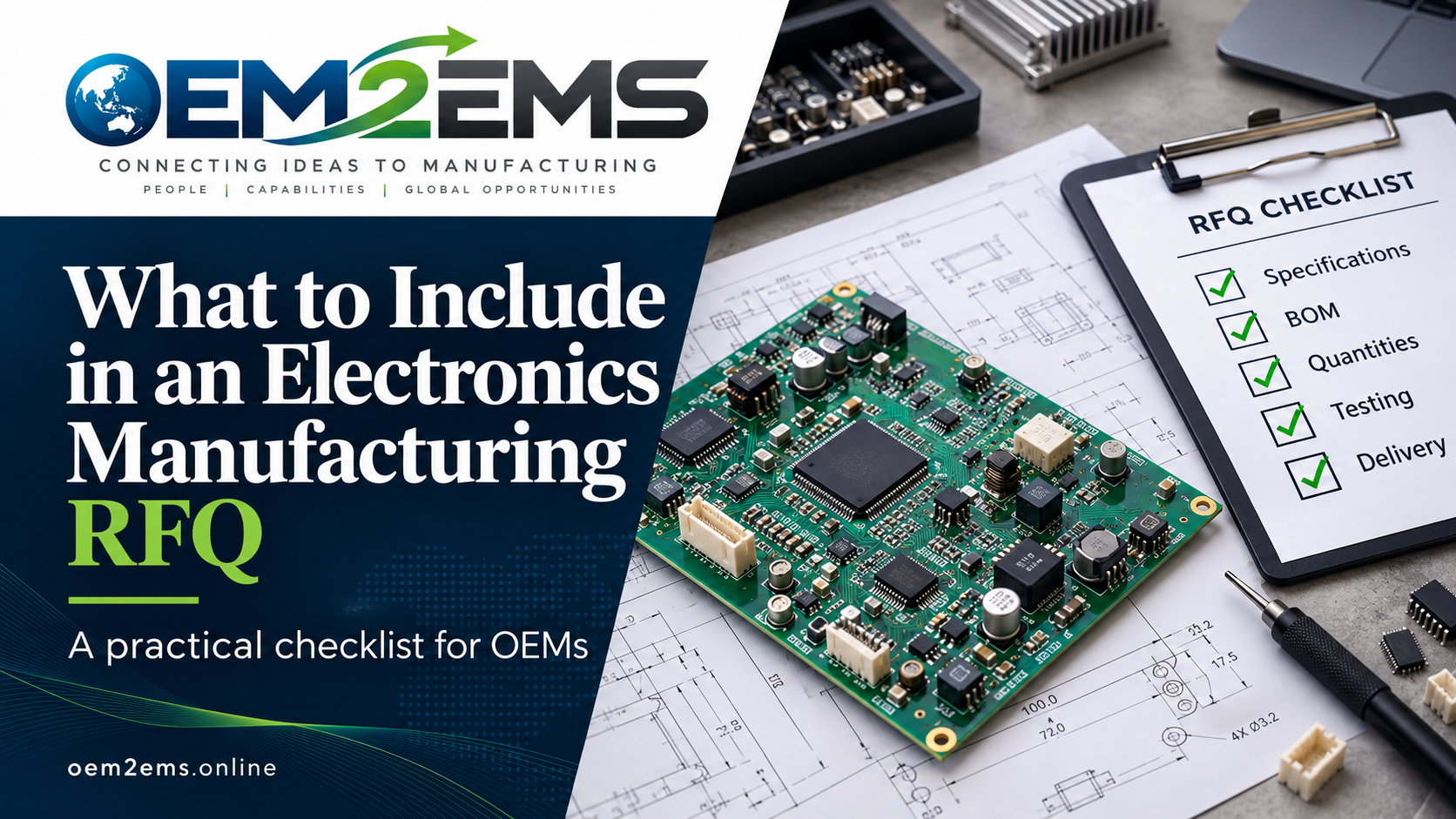
Start with a clear scope
A useful request for quotation (RFQ) helps a manufacturer understand what you need, what they must supply, and how you will evaluate their proposal. It also helps you compare quotations on a consistent basis.
Before asking, “How much will this cost?”, define what the price should include.
1. Explain your product and the work required
Begin with a short product overview and its development stage: prototype, pilot build, existing production, or proposed supplier transfer.
Specify whether you need PCB fabrication, PCB assembly, component sourcing, testing, enclosure assembly, cable harnesses, or complete box build.
For example: “We are seeking a manufacturing partner for an industrial monitoring device. The initial scope includes component sourcing, PCB assembly, firmware programming, functional testing, and final enclosure assembly.”
Clearly identify any work your own team will handle.
2. Prepare your PCB assembly RFQ files and BOM
For PCB assembly, manufacturers commonly request a bill of materials (BOM) and PCB design data. Depending on the supplier and quoting stage, assembly drawings and component-placement files may also be needed. Confirm the manufacturer’s accepted formats before submitting. See the manufacturer file guidance linked under References.
Keep the revisions consistent across documents. Explain missing information rather than leaving the supplier to guess.
- Product name, assembly number, and revision.
- BOM with manufacturer part numbers, quantities, and reference designators.
- PCB fabrication data and relevant drawings.
- Assembly instructions and special requirements.
- Mechanical drawings for enclosures or other manufactured parts, where applicable.
3. State quantities and delivery expectations
Separate your immediate order from your longer-term forecast. The following quantities are illustrative examples, not recommended order sizes.
Label forecasts as estimates unless they represent a firm commitment. Ask the supplier to identify material lead times, manufacturing lead times, and the assumptions behind the proposed delivery date.
- Prototype build: 20 units.
- Pilot build: 100 units.
- Production quotation: pricing for 500 and 1,000 units.
- Estimated annual demand: 5,000 units, subject to customer demand.
- Delivery requirement: state the required arrival date and destination.
4. Define component-sourcing responsibilities
Identify approved alternatives, restricted substitutions, and parts that require your written approval before replacement.
Ask suppliers to flag availability problems and explain any minimum purchases, excess inventory, or non-cancellable material commitments.
- Turnkey sourcing: the manufacturer supplies the materials.
- Consigned assembly: you supply the materials.
- A mixed arrangement: responsibilities are divided.
5. Describe quality, programming, and testing requirements
Avoid relying on a general instruction such as “fully tested.”
Explain the inspections and tests you require, the acceptance criteria, and the records you expect. Include firmware programming, serial-number tracking, traceability, or special handling requirements where relevant.
Clarify who will provide and maintain test procedures, fixtures, software, and reference samples. If these are not ready, ask the manufacturer to quote their development separately.
List applicable customer or product requirements accurately. Confirm that the supplier’s capabilities and certification scope match your needs.
6. Request a clear commercial breakdown
Ask suppliers to distinguish recurring unit costs from one-time charges.
Specify the delivery destination and clarify responsibility for freight, duties, and taxes. A lower unit price may cover a different scope.
- Materials and assembly.
- Programming and testing.
- Tooling, fixtures, setup, and engineering charges.
- Packaging and transport.
- Minimum order quantities and payment terms.
- Quotation validity, exclusions, and pricing assumptions.
7. Ask questions that reveal project fit
Alongside the quotation, ask these questions to evaluate how the supplier would manage your project.
- What information is missing before you can commit to a price and schedule?
- Which activities will be performed in-house or subcontracted?
- How will you manage engineering changes and component substitutions?
- What are the main risks to the proposed schedule?
- Who will coordinate technical questions and production updates?
- How will defects, rework, and corrective actions be handled?
Before you send: RFQ checklist
- Product overview and manufacturing scope are clear.
- Files and drawings use consistent revisions.
- Quantities, forecasts, and delivery expectations are distinguished.
- Material-sourcing responsibilities are assigned.
- Quality, testing, and programming requirements are described.
- One-time charges and recurring costs are requested separately.
- Packaging, delivery destination, and commercial assumptions are stated.
- Open questions and missing information are identified.
- Confidential files are shared through an agreed, appropriate channel.
Not all the details are ready?
You do not need every detail finalized to begin a sourcing conversation. If the design is still evolving, request a budgetary estimate and ask the supplier to document its assumptions.
OEM2EMS supports requirements review, RFQ preparation, supplier-fit discussions, and suitable introductions across the Philippines and Southeast Asia.
References
References provide context and do not imply a partnership or endorsement.